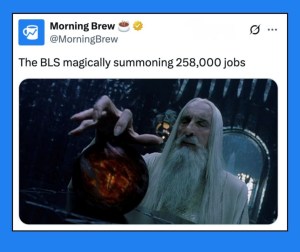
Every hero’s arc has a turning point. When the narrative slips, and a quiet voice whispers: there’s more to this than meets the eye.
Take the labor data. We’re told hiring is strong until the BLS quietly rewrites the story. Last month’s 258K downward revision wasn’t an error. It was business as usual.
First, shape the perception. Later, clean up the numbers.
We’ve seen this before. In 2008, the “resilient” labor market turned out to be anything but. Now savings are drained, delinquencies are spiking, full-time jobs are vanishing, and small businesses are struggling. Yet the Fed still paints a picture of strength.
In this edition of our newsletter, we highlight key economic signals worth tracking and unpack all things Fed and jobs.
A Mirage of Momentum
From the ground level, the economy looks like it’s hitting stall speed. But with markets at all-time highs, the cracks are getting papered over.
- Freight is flashing red: Since February, the freight economy (often an early warning signal) has been in steep decline. Shipping volumes are down, rates are softening, and bankruptcies are accelerating, with five trucking failures reported this week alone.
- Labor sentiment is rolling over: The spread between people saying jobs are “plentiful” and those saying they’re “hard to get” has shrunk to levels that, outside of 2020, haven’t been seen in eight years. In every prior cycle, this has been a leading indicator of a sharp rise in unemployment.
- Growth is concentrated, not broad: Q2 GDP growth looks less impressive when you remove the contribution from net exports. Real consumer spending hasn’t grown since January, and real final sales just posted their weakest quarterly increase in three years.
- AI and health care are carrying the load: The sectors propping up the data aren’t manufacturing, construction, or other high-multiplier industries. They’re narrow pockets like AI infrastructure investment and health care/social assistance jobs.
- Markets are high on sentiment: WSJ summed it up bluntly: “Why are stocks up? Nobody knows.” Investors are chasing momentum while the real economy is already cooling. The gap between perception and reality is widening, and history says that gap eventually closes fast.
When the freight industry is in retreat, labor sentiment is sliding, and growth is coming from low-impact sectors, the rally at the top feels more like a sign of denial than a sign of strength.
Cracks in the Optics
Critical thinkers walked away from the latest Fed meeting seeing more cracks than confidence. Two official dissents (rare in modern Fed history) and signs of a possible third broke through Powell’s carefully managed optics.
The official statement softened its economic outlook, but Powell clung to one data point: the 4.1% unemployment rate.
With immigration slowing, deportations up, and the labor force shrinking, the jobless rate looks steady even as payroll revisions reveal a slowdown. ADP’s numbers (and hard data) show the economy adding just 32K jobs a month over the last year, well below the 100K needed to keep pace with population growth.
Powell’s repeated “efficient” mantra signaled no rush to cut rates until inflation is firmly beaten. But it seems like the Fed is ignoring the reality on the ground: gig workers flooding the market, jobless Americans running out of benefits, and a labor market losing steam.
The risk? By prioritizing optics over action, the Fed could end up chasing the downturn instead of getting ahead of it.
Revisionist History
After months of “strong jobs” headlines, the biggest benchmark revisions in 50 years just stripped the shine off. May and June payroll gains? Slashed to a meager 14k and 19k jobs.
Under the hood, private-sector hiring (outside of healthcare) has been running on fumes for months. Tariff uncertainty has spooked hiring, early AI adoption is quietly reshaping demand for labor, and wage growth is gliding back toward pre-Covid norms.
The punchline: the labor market wasn’t as hot as advertised. It was just noisy data catching up with reality. The BLS monthly surveys are fast but messy, and when they get reconciled to more accurate state payroll records, the mirage fades.
Now, the numbers are lining up with what other indicators (ADP, Challenger, Indeed, ISM) have been hinting at all along: softness. This doesn’t guarantee an imminent Fed cut, but it stacks the odds higher for October or December.
The Gift of Uncertainty
Payroll growth has flatlined over the past three months, and that’s no small signal. Every time this has happened in the last 60 years, a recession followed. Bowman and Waller saw it coming. Their dissent was more pattern recognition than political.
We’re on a part of the journey where the hero doesn’t have all the answers. Just the clarity that they can’t keep doing things the old way. And frankly, that’s a gift.
The ones who act in uncertainty are always the ones who build the future. One step at a time, one truth at a time.
At Dare, we offer a different path, one that’s built on ownership and alignment.
As a Dare Back Room Service partner, you’ll receive:
- Greater Income (like a lot more)
- Owning assets instead of commissions
- Zero investment down
- No personal liability
- Fifty-fifty split on risks and profits
- Portfolio management software from NN6, LLC
Ready to learn more? Give us a call.
If you enjoyed this newsletter, pass it along to your friends.
Until next time,